

























From Road Accidents to Road Carnage, Why Words Matter — and What Must Change on Kenya’s Deadly Roads


Every long weekend, festive season, or rainy month, Kenyans are confronted with grim headlines: dozens dead on highways, families wiped out, buses mangled beyond recognition. Almost instinctively, the media reaches for two familiar phrases — road accident and road carnage. Many readers treat them as interchangeable. They are not. And the difference is more than semantics; it goes to the heart of how Kenya understands, reports, and responds to preventable deaths on its roads.
The term road accident sounds harmless enough. It is neat, official, and widely used in police reports, court proceedings, insurance claims, and government statistics. An accident suggests misfortune — something unintended, perhaps unavoidable. When crashes are framed this way, responsibility is subtly diluted. The human decisions behind speeding, drunk driving, fatigue, poor vehicle maintenance, corruption in licensing, or weak enforcement fade into the background.
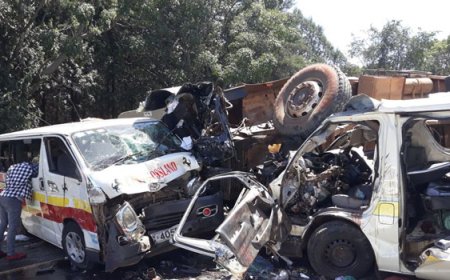
By contrast, road carnage is a word that startles. It is emotive, unsettling, and deliberately graphic. It speaks not of chance but of consequences — twisted metal, lifeless bodies, orphaned children, and communities plunged into grief. When Kenyan headlines scream about “road carnage on the Nakuru–Eldoret highway” or “festive season road carnage,” they are not describing a single incident. They are indicting a pattern — a system that fails with lethal regularity.
This distinction matters because language shapes public perception, and perception shapes policy. Calling a fatal crash an “accident” risks normalising death on the road, turning it into background noise — tragic, yes, but expected. Kenya loses thousands of people annually to traffic crashes, yet the outrage rarely matches the scale of the loss. If similar numbers died every year from collapsing buildings or recurring plane crashes, there would be national mourning, urgent inquiries, and sweeping reforms.
The media’s use of road carnage attempts to restore urgency. It is a linguistic alarm bell, particularly effective in a country where road deaths spike predictably during holidays. The phrase captures cumulative failure: weak enforcement, political interference in regulation, poorly designed roads, unroadworthy public service vehicles, and a driving culture that too often treats rules as suggestions.
The Real Causes Behind Kenya’s Road Deaths
If we are honest, most of what we call “accidents” are anything but accidental. Several recurring causes stand out.
Speeding and reckless driving remain the single biggest killers on Kenyan roads. From highways to urban streets, drivers routinely ignore speed limits, encouraged by lax enforcement and a culture that prioritises haste over safety.
Drunk and drug-impaired driving continues to claim lives despite periodic crackdowns. Enforcement is often sporadic, predictable, or compromised, especially at night and during festive seasons.
Driver fatigue and long hours on the road are frequently overlooked. Many drivers — particularly long-distance PSV operators, truck drivers, and private motorists travelling during holidays — drive for extended hours without rest. Fatigue slows reaction time, impairs judgment, and can be as dangerous as alcohol.
Lack of familiarity with vehicles is another silent risk. Borrowed or hired vehicles behave differently in braking, acceleration, and handling. Drivers unfamiliar with a vehicle’s responsiveness often misjudge distances and speed, with fatal consequences.
Unfamiliarity with roads and routes also contributes significantly. Drivers navigating new highways, diversions, or poorly marked rural roads may underestimate sharp bends, steep gradients, or accident-prone black spots — especially at night or in poor weather.
Poor vehicle condition remains a major concern. Many public service vehicles operate with worn tyres, faulty brakes, or non-functional safety features. Corruption in inspection processes allows unroadworthy vehicles to remain on the road.
Inadequate driver training and licensing have produced generations of motorists ill-prepared for modern traffic conditions. The ease with which licences can be acquired without proper instruction undermines road safety nationwide.
Weak enforcement and corruption further compound the crisis. Traffic laws exist, but bribery at roadblocks erodes deterrence, allowing repeat offenders back on the road with impunity.
Unsafe road infrastructure exposes all road users to danger. Missing pedestrian walkways, unmarked crossings, poor lighting, and inadequate signage disproportionately endanger pedestrians, cyclists, and boda boda riders — who account for a significant share of road fatalities.
These are not acts of fate. They are systemic failures.
From Outrage to Prevention: What Must Be Done
If road carnage is to be more than a headline, it must provoke action. Prevention is possible, and the solutions are well known.
First, consistent, corruption-free enforcement is non-negotiable. Speed limits, drunk-driving laws, and vehicle inspection standards must be enforced daily — not theatrically during holidays.
Second, driver training and licensing must be professionalised. Competency, not connections, should determine who is allowed behind the wheel.
Third, fatigue management must be taken seriously, especially for long-distance and commercial drivers. Mandatory rest periods and monitoring should be enforced.
Fourth, public transport safety must be prioritised. PSV owners and operators should face real consequences — including licence cancellation — for repeat violations.
Fifth, road design must centre human safety. Pedestrian crossings, sidewalks, proper signage, lighting, and road markings save lives and reduce driver error.
Finally, public education must be continuous, not seasonal. Drivers must be warned about the risks of unfamiliar vehicles, new routes, and long hours behind the wheel — backed by enforcement, not slogans.
Globally, there is a growing shift away from the word accident toward road crash or collision, terms that acknowledge causation without sensationalism. Kenya may eventually follow suit. For now, road carnage remains the language of moral outrage — a refusal to sanitise preventable death.
Words alone will not make Kenyan roads safer. Accountability will. Whether we call it an accident, a crash, or carnage, the real question is what follows the headline. Are offenders punished? Are dangerous roads redesigned? Are enforcement agencies empowered — and compelled — to act without fear or favour?
Until those answers are matched by action, Kenya will continue to bury its dead, headline after headline, debating language while ignoring the systems — and choices — that keep killing us.
What's Your Reaction?
 Like
0
Like
0
 Dislike
0
Dislike
0
 Love
0
Love
0
 Funny
0
Funny
0
 Angry
0
Angry
0
 Sad
0
Sad
0
 Wow
0
Wow
0